
Key Takeaways
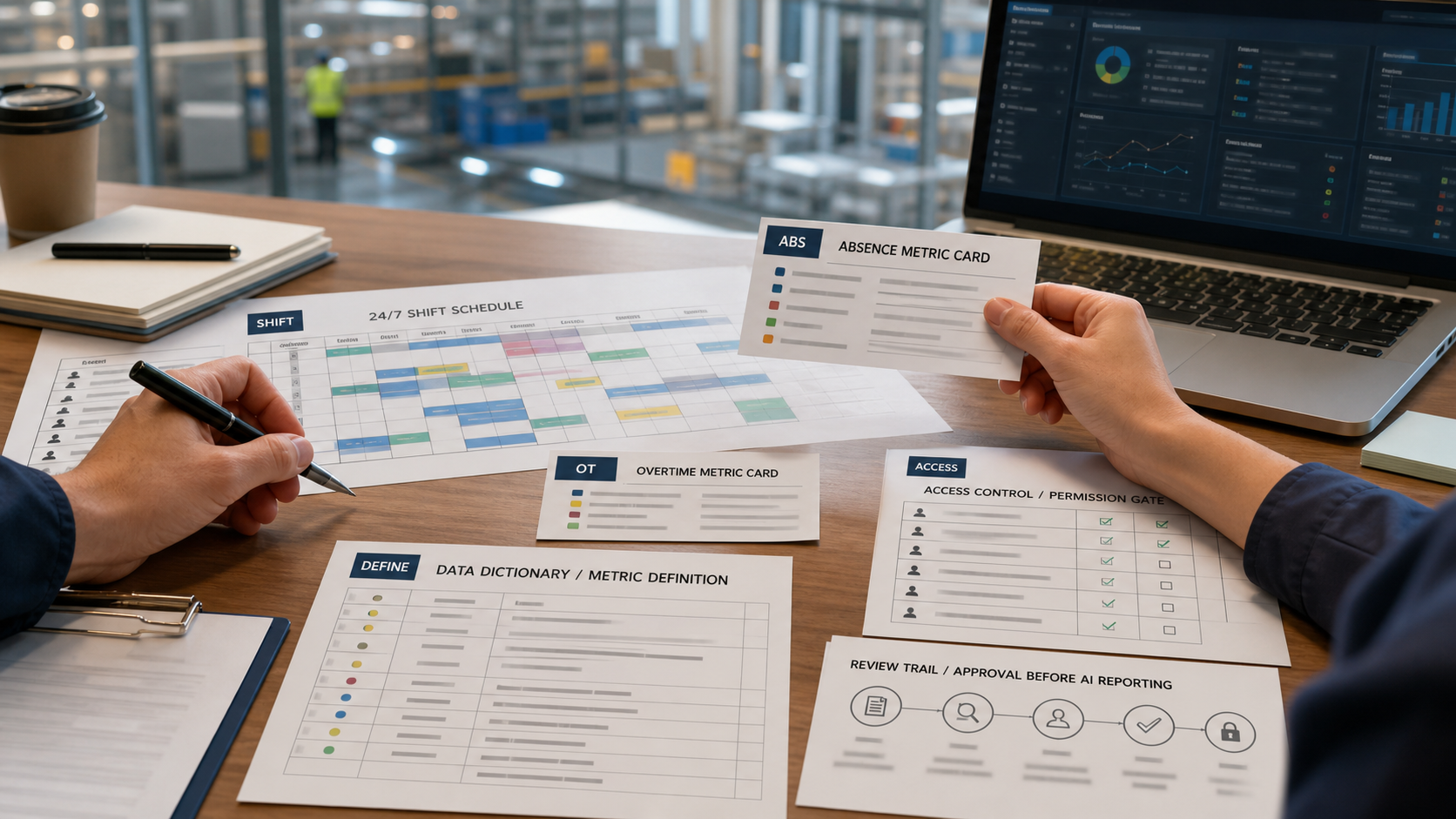
- A June 19, 2026 announcement about Indeavor shows a more operational scene than AI writing HR documents. Frontline workforce data such as scheduling, absence, and overtime is being connected directly to natural-language queries and dashboards.
- The core of this change is not “adopting an AI dashboard.” In 24/7 operating environments, the issue is who can view scheduling and absence data, by what standards, and for which decisions.
- For Korean companies, the point to study is less the vendor feature itself and more the data dictionary, permissions, accountable owners, and metric interpretation standards. Absence and overtime indicators in particular should be read as organizational operating signals before they are connected directly to individual evaluation.
Before AI dashboards, HR must define frontline data
A Techrseries announcement published on June 19, 2026 described Indeavor’s AI Analytics Hub as a “natural language reporting platform.” The target environment is also relatively clear. It refers to complex 24/7 operations and four industries where frontline shifts and regulation matter: manufacturing, food and beverage, energy, and nuclear.
The notable point is the data being connected. The announcement explains that the tool connects directly to scheduling and absence data. From an HR perspective, this is not a small shift. When recruitment, attendance, staffing, absence, and overtime remain in separate tables and systems, more time is spent checking consistency than analyzing the workforce. Before AI makes the screen look polished, HR has to decide whether the same word, such as “absence,” means the same thing by department, site, and period.
That is why frontline workforce AI analytics is closer to an operating-model issue than to a subfunction of People Analytics. If field names, aggregation months, absence types, overtime formulas, and exception rules are unclear, AI may answer quickly while the organization becomes unstable slowly. Fast numbers make meetings easier. They do not necessarily mean the numbers are right.
Natural-language queries widen access but can blur permission boundaries
The announcement says users can ask questions in plain English instead of using SQL or spreadsheets. The examples are concrete: compare absence trends by facility last month, or show overtime in the production department last week. It also emphasizes that site managers, HR, and enterprise leadership can see the information directly without analyst or IT support.
This accessibility is clearly useful. Frontline leaders do not have to wait for every Excel extract, and HR can reduce the burden of answering the same questions repeatedly. But weak permission design creates another problem. How much of another facility’s absence trend may one site manager see? By what standard is personally identifiable data masked? Who audits the AI query log?
Natural-language querying does not simply make analysis easy for everyone. It tests the boundaries of analytical permission more often. HR should decide at least three things before adoption: first, role-based viewing scopes; second, minimum display thresholds for individual-, team-, and facility-level data; and third, separate approval procedures when sensitive indicators are moved into performance evaluation or disciplinary decisions.
Overtime and absence metrics are operating signals, not productivity scores
The examples in the announcement are absenteeism trends and production department overtime. They are questions tied to periods and units, such as last month’s absence by facility or last week’s overtime in production. It also explains that smart insights can reveal risks and trends such as overtime spikes and staffing gaps.
What HR must be careful about here is the speed of interpretation. An increase in overtime does not immediately mean productivity has improved. A rise in absence cannot be assigned directly to individual responsibility either. The same week of overtime may hide different causes, including a demand surge, equipment issues, insufficient training, shift-table design, or a leadership gap.
AI analytics results should therefore begin as a question sheet, not an evaluation sheet. If overtime suddenly jumps by site, HR should review staffing, work reallocation, safety risk, and manager approval patterns together. If absenteeism rises, HR should examine health, burnout, commuting, rest time between shifts, and even how absence codes are entered. Metrics are not tools for marking people down. They are signals for finding bottlenecks in operations.
Korean companies should set data dictionaries and accountable owners before vendor adoption
The announcement presents benchmarking and standardization, automated delivery, and standardized dashboards as features. These give HR a practical hint. Benchmarking is an attractive word, but comparison quickly becomes distorted without standard definitions. Even the same absence rate can become a completely different number depending on how paid leave, sick leave, unauthorized absence, and shift changes are classified.
If Korean companies review tools of this kind, they should first build a data dictionary. It is a document that organizes field names, formulas, denominators, base months, exclusions, approvers, and editing permissions. The second step is to designate accountable owners. If it is unclear whether HR owns the metric, production and operations own it, or IT is responsible for data quality, the AI tool may produce answers but execution will stop.
Finally, the purpose of automated reports must be limited. A standard dashboard sent weekly to executives is different from a report for frontline improvement meetings. If data is used for evaluation, discipline, or compensation decisions, review procedures and appeal channels are also needed. The success or failure of an AI analytics tool is likely to be determined more by operating rules than by the model itself.
Practical checklist questions
- Are the data definitions for shift work, absence, overtime, and replacement work the same across departments?
- For natural-language query users, which facility-, team-, and individual-level data can each role view?
- Who reviews and acts on staffing gaps or overtime spikes suggested by AI?
- Is an automatically delivered dashboard classified as decision material, monitoring material, or evaluation material?
- Before vendor adoption, are the data dictionary, permission table, audit log, and exception approval process documented?
What HR should look at next
The point is not to add one more policy. The work ahead is to turn this issue into a clear operating standard for the organization.
A practical starting question is enough: which decision will this change actually alter — hiring, performance management, learning, or rewards? The clearer that answer becomes, the closer HR work moves from reports to real standards used in the field.
References: Techrseries, “Indeavor Launches AI Analytics Hub to Turn Frontline Workforce Scheduling and Absence Data Into Real-Time Insights With AI”, 2026-06-19. https://techrseries.com/hr/indeavor-launches-ai-analytics-hub-to-turn-frontline-workforce-scheduling-and-absence-data-into-real-time-insights-with-ai/
![[2026 HR Trend ③] The End of Annual Reviews: Redesigning Performance Management in the Age of AI Coaching](https://hr.widion.com/wp-content/uploads/2026/06/1397-distinct-coaching_conversation-1.png)
![[2026 HR Trend ②] More Important Than AI Adoption: Designing HR’s Lines of Accountability for AI](https://hr.widion.com/wp-content/uploads/2026/06/1401-distinct-audit_gate_detail-1.png)

![[OKR Series ⑧] OKRs in the Age of AI and People Analytics: Goal Management Becomes a Competition of Interpretation, Not Automation](https://hr.widion.com/wp-content/uploads/2026/06/1312-okr-ai-people-analytics-interpretation-series-08.png)
![[OKR Series ⑦] For OKRs to Take Root in Korean Companies, the Operating Language Must Change Before the System](https://hr.widion.com/wp-content/uploads/2026/06/1307-okr-korean-operating-language-series-07.png)
![[OKR Series ⑥] In OKR Operations, the Leader’s Role Is Not to Push Goals but to Adjust Priorities](https://hr.widion.com/wp-content/uploads/2026/06/1305-okr-leader-priority-adjustment-series-06.png)
![[OKR Series ⑤] The Moment OKRs Are Reflected in Evaluation, Stretch Goals Turn into Safe Goals](https://hr.widion.com/wp-content/uploads/2026/06/1295-okr-evaluation-compensation-series-05.png)
![[OKR Series ④] OKR Implementation Fails Not Because There Are Too Many Goals, but Because Accountability Gets Blurred](https://hr.widion.com/wp-content/uploads/2026/06/1294-okr-responsibility-blur-series-04.png)