AIHR, HR Tech & People Analytics

AI-enabled HR transformation, HR SaaS, People Analytics, AI agents, ATS, LMS, automation, privacy, fairness and data governance.

  • When Frontline Workforce Data Moves Into AI Analytics, HR Must Control Metrics Before Dashboards

    When Frontline Workforce Data Moves Into AI Analytics, HR Must Control Metrics Before Dashboards

    Key Takeaways

    • A June 19, 2026 announcement about Indeavor shows a more operational scene than AI writing HR documents. Frontline workforce data such as scheduling, absence, and overtime is being connected directly to natural-language queries and dashboards.
    • The core of this change is not “adopting an AI dashboard.” In 24/7 operating environments, the issue is who can view scheduling and absence data, by what standards, and for which decisions.
    • For Korean companies, the point to study is less the vendor feature itself and more the data dictionary, permissions, accountable owners, and metric interpretation standards. Absence and overtime indicators in particular should be read as organizational operating signals before they are connected directly to individual evaluation.

    Before AI dashboards, HR must define frontline data

    A Techrseries announcement published on June 19, 2026 described Indeavor’s AI Analytics Hub as a “natural language reporting platform.” The target environment is also relatively clear. It refers to complex 24/7 operations and four industries where frontline shifts and regulation matter: manufacturing, food and beverage, energy, and nuclear.

    The notable point is the data being connected. The announcement explains that the tool connects directly to scheduling and absence data. From an HR perspective, this is not a small shift. When recruitment, attendance, staffing, absence, and overtime remain in separate tables and systems, more time is spent checking consistency than analyzing the workforce. Before AI makes the screen look polished, HR has to decide whether the same word, such as “absence,” means the same thing by department, site, and period.

    That is why frontline workforce AI analytics is closer to an operating-model issue than to a subfunction of People Analytics. If field names, aggregation months, absence types, overtime formulas, and exception rules are unclear, AI may answer quickly while the organization becomes unstable slowly. Fast numbers make meetings easier. They do not necessarily mean the numbers are right.

    Natural-language queries widen access but can blur permission boundaries

    The announcement says users can ask questions in plain English instead of using SQL or spreadsheets. The examples are concrete: compare absence trends by facility last month, or show overtime in the production department last week. It also emphasizes that site managers, HR, and enterprise leadership can see the information directly without analyst or IT support.

    This accessibility is clearly useful. Frontline leaders do not have to wait for every Excel extract, and HR can reduce the burden of answering the same questions repeatedly. But weak permission design creates another problem. How much of another facility’s absence trend may one site manager see? By what standard is personally identifiable data masked? Who audits the AI query log?

    Natural-language querying does not simply make analysis easy for everyone. It tests the boundaries of analytical permission more often. HR should decide at least three things before adoption: first, role-based viewing scopes; second, minimum display thresholds for individual-, team-, and facility-level data; and third, separate approval procedures when sensitive indicators are moved into performance evaluation or disciplinary decisions.

    Overtime and absence metrics are operating signals, not productivity scores

    The examples in the announcement are absenteeism trends and production department overtime. They are questions tied to periods and units, such as last month’s absence by facility or last week’s overtime in production. It also explains that smart insights can reveal risks and trends such as overtime spikes and staffing gaps.

    What HR must be careful about here is the speed of interpretation. An increase in overtime does not immediately mean productivity has improved. A rise in absence cannot be assigned directly to individual responsibility either. The same week of overtime may hide different causes, including a demand surge, equipment issues, insufficient training, shift-table design, or a leadership gap.

    AI analytics results should therefore begin as a question sheet, not an evaluation sheet. If overtime suddenly jumps by site, HR should review staffing, work reallocation, safety risk, and manager approval patterns together. If absenteeism rises, HR should examine health, burnout, commuting, rest time between shifts, and even how absence codes are entered. Metrics are not tools for marking people down. They are signals for finding bottlenecks in operations.

    Korean companies should set data dictionaries and accountable owners before vendor adoption

    The announcement presents benchmarking and standardization, automated delivery, and standardized dashboards as features. These give HR a practical hint. Benchmarking is an attractive word, but comparison quickly becomes distorted without standard definitions. Even the same absence rate can become a completely different number depending on how paid leave, sick leave, unauthorized absence, and shift changes are classified.

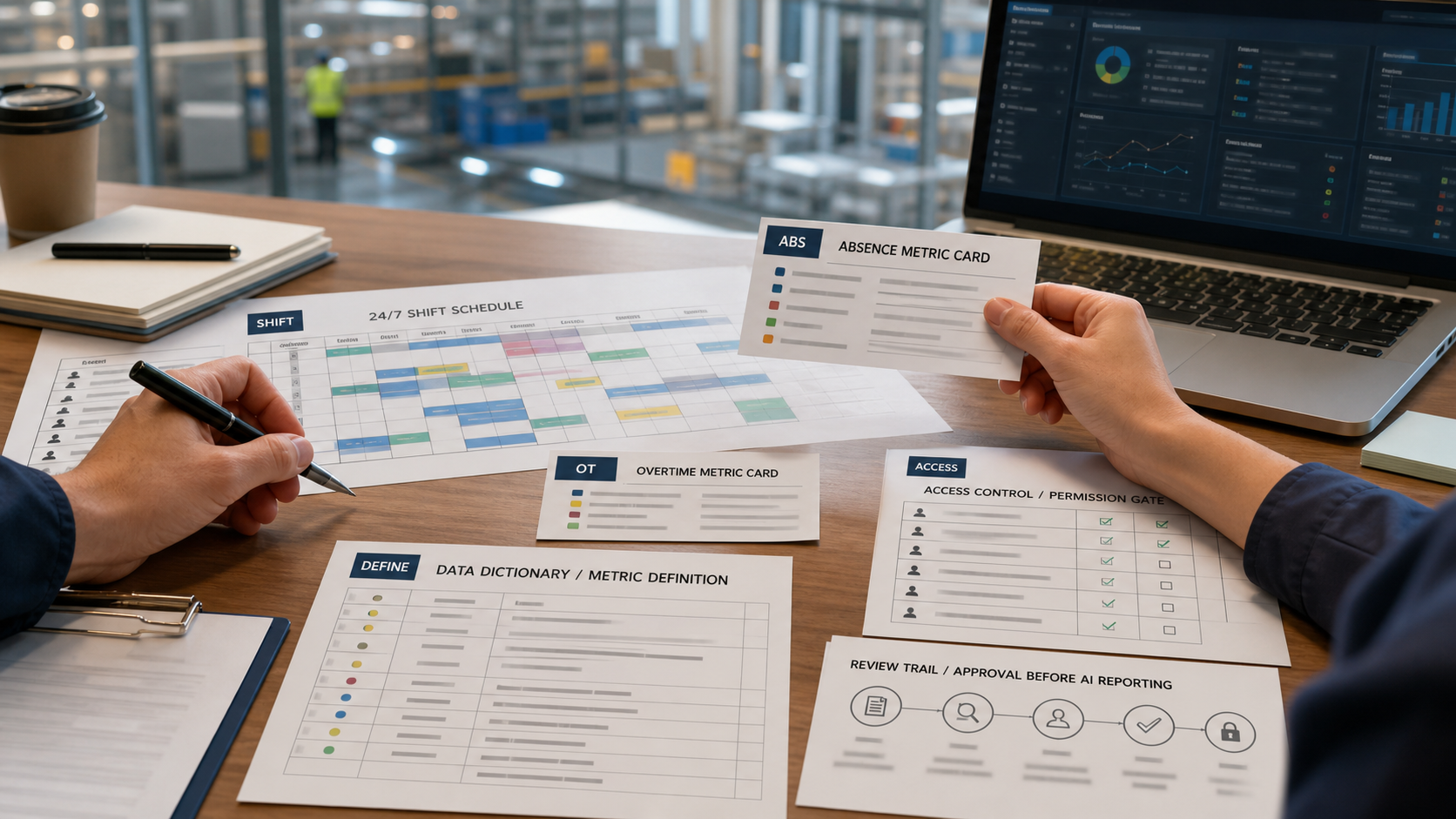
    If Korean companies review tools of this kind, they should first build a data dictionary. It is a document that organizes field names, formulas, denominators, base months, exclusions, approvers, and editing permissions. The second step is to designate accountable owners. If it is unclear whether HR owns the metric, production and operations own it, or IT is responsible for data quality, the AI tool may produce answers but execution will stop.

    Finally, the purpose of automated reports must be limited. A standard dashboard sent weekly to executives is different from a report for frontline improvement meetings. If data is used for evaluation, discipline, or compensation decisions, review procedures and appeal channels are also needed. The success or failure of an AI analytics tool is likely to be determined more by operating rules than by the model itself.

    Practical checklist questions

    • Are the data definitions for shift work, absence, overtime, and replacement work the same across departments?
    • For natural-language query users, which facility-, team-, and individual-level data can each role view?
    • Who reviews and acts on staffing gaps or overtime spikes suggested by AI?
    • Is an automatically delivered dashboard classified as decision material, monitoring material, or evaluation material?
    • Before vendor adoption, are the data dictionary, permission table, audit log, and exception approval process documented?

    References: Techrseries, “Indeavor Launches AI Analytics Hub to Turn Frontline Workforce Scheduling and Absence Data Into Real-Time Insights With AI”, 2026-06-19. https://techrseries.com/hr/indeavor-launches-ai-analytics-hub-to-turn-frontline-workforce-scheduling-and-absence-data-into-real-time-insights-with-ai/
  • AI Is Said to Eliminate Entry-Level Roles, but HR Should First Redesign Work

    AI Is Said to Eliminate Entry-Level Roles, but HR Should First Redesign Work

    The claim that AI will eliminate entry-level jobs spreads quickly. But the first question HR should examine is slightly different. It is less about which jobs disappear and more about how the tasks once handled by entry-level employees are being broken apart and recombined.

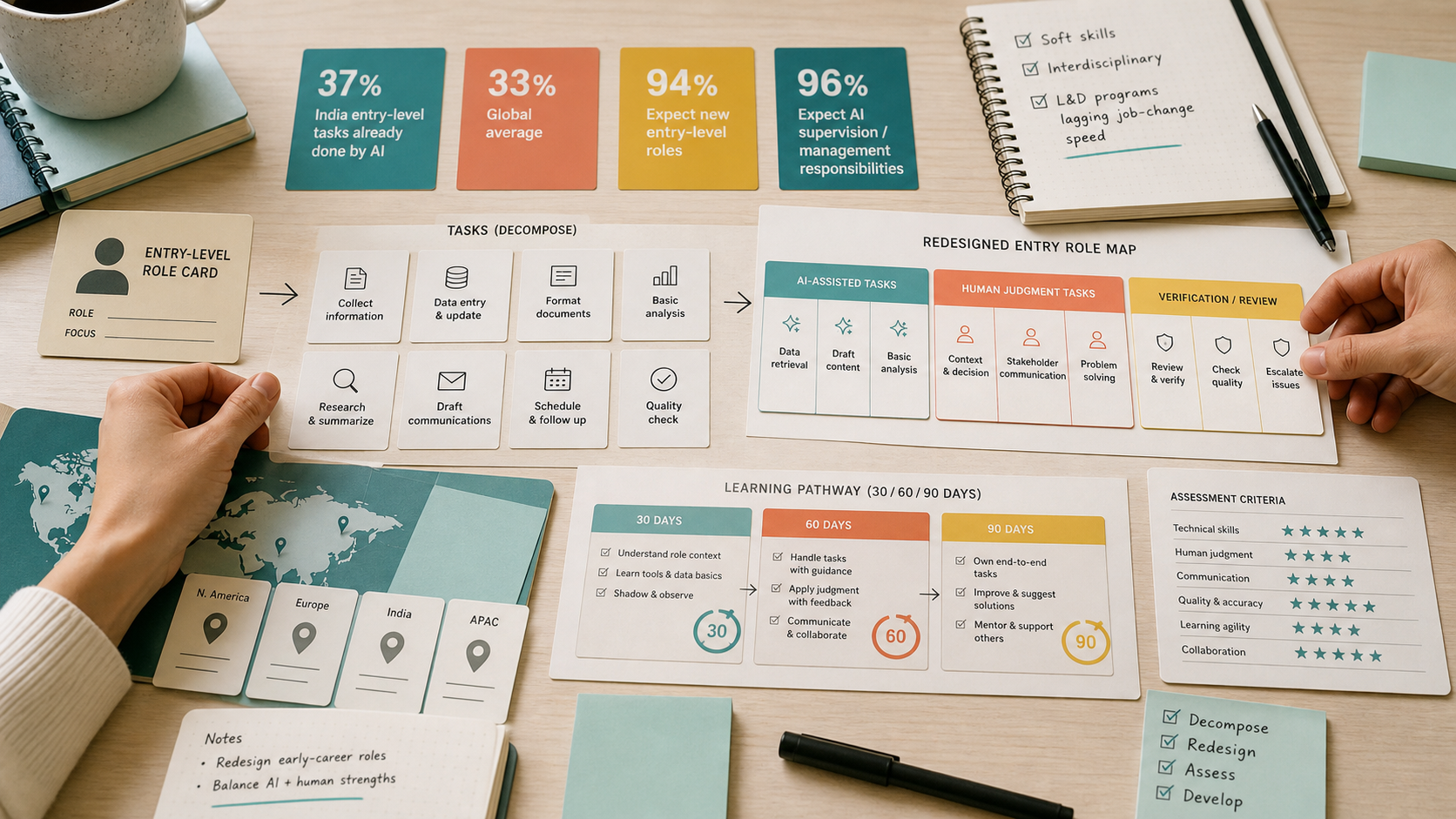
    A survey summary released by Cognizant and Pearson on June 18 shows this distinction clearly. It said that in India, 37% of entry-level role tasks are already performed by AI, while the global average is 33%. At the same time, 94% of HR leaders said AI will create new entry-level roles within the next five years. Replacement and creation appear in the same table.

    The entry-level jobs debate should start with task composition, not replacement rates

    The most striking figure in the survey summary is 37%. That is the share of entry-level job tasks in India that AI already performs. It is higher than the global average of 33%. In addition, 18% of HR leaders said AI is handling more than half of entry-level work. Looking only at the numbers, anxiety can come first.

    But if HR reads these figures immediately as “reduced entry-level hiring,” its judgment becomes too blunt. Even when some tasks move to AI, the whole job does not necessarily disappear. Recruiters should instead separate the repeated data entry, drafting, information search, verification, customer response, and internal coordination tasks inside job descriptions. Some tasks will be automated, while others will require more human judgment.

    Hiring criteria are moving from majors to the ability to work with AI

    In the Cognizant and Pearson survey, 96% of HR leaders expected entry-level roles to evolve toward supervising or managing AI systems within five years. Another 94% said AI will create new entry-level roles that do not exist today. This point means the focus of hiring criteria is moving from “Can this person use AI?” to “Can this person review AI output and adapt it to the context?”

    What is interesting is that the summary does not emphasize technical majors alone. It reported that 97% of HR professionals said soft skills have become more important, and 69% said a broad interdisciplinary background is more important for early-career talent than narrow specialization. If Korean companies revisit their entry-level hiring scorecards, they should look beyond major names, certificates, and tool experience. Problem definition, AI-output verification, and the ability to explain work collaboratively should be evaluated together.

    Training demand is rising, but L&D is falling behind the pace

    According to the survey summary, 91% of HR professionals said demand for AI training among employees increased over the past 12 months. Yet 60% said L&D programs are not keeping up with the pace of AI-driven job change, and the figure was presented as 63% among respondents in India. The gap between training demand and training supply has already become an operating issue.

    At this point, HRD needs to create task maps by job before adding one-off AI lectures. For example, in entry-level sales, marketing, development support, and HR operations roles, HRD should separate the drafting, search, and classification tasks handled by AI from the judgment tasks people must confirm. Training indicators also cannot stop at the number of participants. Actual task-transition rates after training, manager feedback, error-review standards, and changes in onboarding time should be checked together.

    Middle managers become the bottleneck in AI hiring and onboarding

    In the Cognizant and Pearson survey, 95% of HR leaders said middle managers are important in ensuring employees use AI effectively. Another 92% said middle managers play an important role in redefining job roles as AI changes daily work. Even if a company hires entry-level employees, change will stop at the wording of the job posting if frontline managers cannot redistribute work between AI and people.

    HR’s next diagnostic questions therefore need to be concrete. First, has the organization written down the tasks AI has taken over and the new verification tasks for each entry-level role? Second, does onboarding teach judgment standards and prohibited uses, not only how to use AI tools? Third, have middle managers been given role-redesign authority and coaching language? Fourth, for companies that maintain large-scale early-career hiring, as in Cognizant’s case of hiring 20,000 entry-level employees in 2025 and planning to exceed that number in 2026, are education, placement, and managers’ execution capabilities expanding together?

    The same percentages cannot be applied directly to Korean companies. The survey covered three countries—the United States, the United Kingdom, and India—and surveyed 750 director-level or higher HR professionals at companies with more than 1,000 employees. The sample and respondent composition were collected through an online survey from March 23 to April 3, 2026. Still, the message is clear. The core question in entry-level hiring in the AI era is not “How many people can we reduce?” but “Which tasks must we redesign, and which skills must we build early?” If HR misses this question, AI becomes not the answer to workforce planning but another cause of onboarding failure.

  • AI Training Participation Lags Adoption, Exposing a Bottleneck in the HR Operating Model

    AI Training Participation Lags Adoption, Exposing a Bottleneck in the HR Operating Model

    Installing AI tools is not the same as people actually changing how they work. Aon’s June 17 article makes that gap quite clear. It notes that nearly three-quarters of organizations worldwide have deployed AI or are running pilots, while only 18% of organizations have most employees participating in AI reskilling and upskilling.

    That number signals that HR teams need to change the first question they ask about AI projects. The question should not start with “which tool did we introduce?” It should start with “who learned it, which work changed, and is that change visible in performance indicators?” Even when adoption rates are high, low learning participation and weak operating standards reveal the bottleneck inside the HR operating model.

    The gap between deployment and learning participation appears first

    Aon’s insight dated June 17, 2026 explains that AI deployment and pilot programs are already widespread. In numerical terms, nearly three-quarters of organizations worldwide have deployed AI or are testing it. From the employer perspective, it also says that more than three-quarters have already rolled out AI tools. On the surface, AI transformation looks fast.

    But the second number in the same material is more uncomfortable. Only 18% of organizations have most employees participating in AI reskilling and upskilling. The gap between deployment and learning participation is not simply a delayed training schedule. It may mean that HRD budgets, job-based priorities, manager roles, and work redesign are not connected on the same operational view.

    Counting usage frequency alone does not show the return on AI investment

    Aon points out that AI use is still often measured by “frequency of use.” How many people logged in, how many prompts were entered, and which teams used tools most frequently can work as early diffusion indicators. But those indicators alone cannot show whether hiring lead time, training conversion rates, customer response quality, document review time, or the speed of managerial decision-making have improved.

    Training coverage shows the same problem. Aon wrote that fewer than one-third of employers have failed to train even 10% of their workforce, and that one in six has not trained any employees at all. If an AI project meeting ends after reviewing only “number of users,” this gap remains hidden. HR needs to connect training audiences, job groups, use cases, and before-and-after performance indicators.

    HRD and People Analytics need to look at the same dashboard

    AI training is now difficult to run as a standalone campaign. The 18% participation figure is not only an HRD issue. It is an operating indicator that People Analytics, HRBPs, IT, and business leaders need to review together. For example, organizations should not look only at training completion rates. They should also place next to them the share of work actually using AI after training, the number of approved use cases, and the number of processes that have completed risk review.

    John McLaughlin said that organizations are deploying AI but are not providing enough clarity, direction, and operating model support for people to use it effectively. That sentence can be read as a checklist for the HR operating model. Are there job-specific standards for AI use? What outputs should managers approve? What should be compared 30, 60, and 90 days after training? Without these questions, AI use is left to individual curiosity.

    The next question for Korean companies is readiness, not tools

    Aon’s material is written from a global consulting perspective, so it does not replace explanations of Korean companies’ legal obligations or industry-specific rules. In this automated run, the sample, survey scope, and industry distribution of respondents were not checked in detail, so the figures should be read as signals for workforce-readiness diagnosis. Still, there is a warning HR practitioners can apply: if AI transformation is treated only as a solution deployment project, training, roles, performance measurement, and accountability structures will not catch up.

    In the next AIHR meeting, it may be better to open a readiness table before reviewing the feature list. HR should check, line by line, training participation by job group, actual applied work, manager approval standards, prohibited use cases, performance indicators, and data-security review status. If the tools are already inside the organization, the question needs to be asked before it is too late: are we increasing the number of people who use AI, or are we redesigning work that can actually use AI?

  • [2026 HR Trend ②] More Important Than AI Adoption: Designing HR’s Lines of Accountability for AI

    [2026 HR Trend ②] More Important Than AI Adoption: Designing HR’s Lines of Accountability for AI

    This is the second article in the 2026 HR Trend series. If the first article read the overall flow as a “redesign of the HR operating model,” this article focuses on AI within that flow. The key issue is not AI adoption rate. It is how far HR will use AI, who will review it, and how it will explain decisions to employees.

    SHRM expects AI to remain a central HR agenda item in 2026. At the same time, it explains that organizations must revisit whether AI has delivered the expected results and where costs and risks are hidden. It also presents the figure that 89% of CEOs expect AI to redefine how organizations create and capture value. As expectations grow, responsibility grows as well.

    As AI becomes a central HR agenda, lines of accountability must come first

    AI is rapidly entering recruiting, performance management, learning, workforce planning, and employee-experience analysis. But saying that HR uses AI is not a single action. AI that summarizes candidate documents, AI that recommends interview questions, AI that drafts performance feedback, and People Analytics tools that predict turnover risk each create different risks.

    The problem is that as tools multiply, the source of judgment becomes blurred. If there is no record of whether HR simply followed the AI output, whether a manager modified it, or what criteria justified an exception, employees will find it difficult to accept the result. Therefore, the first task for HR AI in 2026 is not “what should we adopt?” but “who is the final decision-maker?”

    HR AI accountability starts with three questions

    The first question is purpose of use. SHRM’s 2026 HR Trends explains that organizations should strip away excessive expectations around AI and use it where it truly matters. HR must therefore distinguish whether AI is being used for cost reduction, productivity improvement, or as a supporting tool for better workforce decisions. If the purpose is vague, performance is hard to measure.

    The second question is review responsibility. Who checks the recommendations made by AI? In recruiting, the roles of recruiters and business leaders differ; in performance management, the responsibilities of managers and HRBPs differ. The third question is documentation standards. Organizations must leave a record of what data was entered, by what criteria results were revised, and who approved exceptions.

    If these three questions are not settled, AI may make HR faster, but it will not make HR more trusted.

    For recruiting AI, explainability matters more than screening speed

    In 2026 Talent Trends, SHRM addresses hiring difficulties and skill shortages based on data from more than 2,000 HR professionals. According to the public summary, about 70% of HR professionals still face difficulty hiring full-time employees, and 42% experienced difficulty retaining full-time employees in the past 12 months.

    In this situation, recruiting AI looks like an attractive solution because it can quickly summarize applications, classify candidates, and generate interview questions. Yet, as SHRM points out, automation and algorithms alone cannot solve hiring problems. If job requirements are outdated and evaluation criteria are unclear, AI will only repeat that ambiguity faster.

    Therefore, the core of recruiting AI is not speed but explainability. HR must be able to explain why a candidate was excluded, what capabilities were judged insufficient, and how humans reviewed the AI recommendation.

    Performance-management AI should make managerial judgment more transparent

    AI coaching and People Analytics are also changing performance management. SHRM’s 2026 HR Trends explains that AI can go beyond cost reduction and productivity improvement and lead to better workforce decisions. SHRM’s 2026 trend commentary also addresses the idea that AI coaches may accelerate the end of annual performance reviews. This does not mean evaluation disappears. Rather, feedback must become more frequent, more specific, and more data-based.

    Here again, accountability lines matter. AI can draft an employee development plan. But managers must decide what feedback to actually deliver, what goals to adjust, and what performance issues to leave as formal records. HR should not let AI replace managerial judgment; it should use AI as a mechanism that makes the judgment process more consistent and transparent.

    Korean companies should keep records of AI use and exception criteria

    The first task for Korean companies is not a grand AI ethics declaration but the maintenance of operating documents. Translating SHRM’s framing of the 2026 AI agenda as a matter of cost, risk, productivity, and workforce decisions into Korean HR operations means separating AI-use standards first in areas that affect employees, such as recruiting, performance management, learning recommendations, and turnover-risk analysis.

    For example, recruiting must distinguish whether AI only summarizes applications or also ranks candidates. Performance management must separate whether AI feedback wording is reference material or formal evaluation evidence. HR data analytics needs standards for whether individual-level predictions are provided to managers or used only as organization-level indicators.

    The competitiveness of HR AI in 2026 does not lie in using more tools. It lies in creating a structure in which people can review and explain the judgments made by AI. That is the starting point for HR to turn AI into an asset of organizational trust.

    2026 HR Trend series articles

    The AI accountability article connects the flow of HR AI operations when read together with the hub article and the performance-management article.

    Read the HR Trend series together

    This article is part of the 2026 HR Trend series. Reading AI adoption, accountability lines, performance management, recruiting, upskilling, mixed workforces, Polywork, and employee experience together provides a more three-dimensional view of changes in the HR operating model.

    References

    This article was written based on SHRM’s 2026 HR Trends, 2026 Talent Trends, and 2026 HR trend commentary. In particular, the HR professional respondent sample and public figures from 2026 Talent Trends were used as article-level evidence. Only figures and wording verifiable in public materials were used as evidence in the body, and nonpublic content from member-only detailed reports was not cited.

  • AI HR adoption makes compliance infrastructure a core variable in HR Tech investment

    AI HR adoption makes compliance infrastructure a core variable in HR Tech investment

    The figure of 97 HR Tech deals and $2.8 billion in Q1 2026 may look like just another investment headline. Yet the more important point in HR Executive’s June 15 report is not the deal value, but the shifting center of gravity in investment judgment. As AI agents enter recruiting, performance management, and workforce planning, HR systems become more than tools that process work quickly. They become systems that must leave evidence of “who approved an action, whether communication was appropriate, and which workflow created regulatory exposure.”

    The key issue for HR leaders is not the name of a particular vendor or report. It is the compliance infrastructure that can easily be missed when AIHR investment meetings compare only automation features: approval logs, bias audits, data flows, and accountability are moving into the center of the HR operating model.

    HR Tech buying criteria are moving from automation speed to accountability tracking

    According to the Norwest Venture Partners analysis introduced by HR Executive, Q1 2026 HR Tech activity reached 97 deals worth $2.8 billion. ADP’s acquisition of WorkForce Software was cited at $1.2 billion, and Workday’s acquisition of Sana at $1.1 billion. On the surface, these are major M&A headlines. From an HR perspective, the more important signal is that governance and compliance layers are becoming more important than automation features alone.

    As AI agents spread across HR workflows, the compliance surface expands with them. For HR leaders, the point to watch is not the number of automation features, but whether accountability can be traced. Once job posting drafts, candidate screening, performance feedback drafts, and workforce planning scenarios pass through AI, keeping only the final output is not enough. Who approved the tool and under what standard, where exceptions are recorded, and how far model output replaced human judgment become purchasing requirements.

    The risk of AI recruiting and performance tools does not end with the vendor contract

    The legal and regulatory risks around AI HR tools are also becoming more concrete. Companies using AI in recruiting, performance management, and workforce planning need to explain accountability across a patchwork of regional requirements and existing anti-discrimination principles. Colorado’s impact-assessment requirements for high-risk AI systems, Illinois restrictions on AI video interviews, and New York City’s bias audit requirement for automated employment decision tools all point in the same direction.

    Because these are U.S. rules, Korean companies should not read them as directly applicable obligations. Still, they leave a clear common question for HR operations. The fact that a company used a third-party AI tool does not automatically reduce the employer’s responsibility. The comment by Littler’s Britney Torres, reported by HR Executive, points in the same direction: courts may look at both AI-specific authority and general anti-discrimination law when judging responsibility for biased employment decisions.

    Korean HR teams should ask first about approval logs and data flows, not feature lists

    Compliance and HR service management are connected to work that is difficult to stop, such as employee relations case management, compliance training, and background screening. The discussion is limited to the U.S. HR Tech market, but it is still meaningful that these operational items appeared alongside the Q1 2026 flow of 97 deals and $2.8 billion. In an environment where AI agents affect HR decisions at volume, one missing log can later become an impossible-to-explain decision.

    When Korean companies apply this discussion, it is more practical to map internal data flows first than to memorize U.S. regulatory names. They need to identify which systems handle sensitive HR data such as candidate information, evaluation comments, manager feedback, training completion records, and performance ratings, and where AI recommends, summarizes, classifies, or executes actions. The Colorado impact-assessment example, Illinois AI video interview restrictions, and New York City bias audit requirement should be read less as domestic legal obligations and more as signals to turn approvers, change histories, exception handlers, retention periods, vendor access rights, and bias-check cycles into standard review items.

    The next HR Tech review meeting is already late if it starts with “what can we automate?”

    The questions HR Tech review meetings need to ask are direct: who authorized the action, whether the communication was appropriate, and whether the workflow created regulatory exposure. Those three questions change the order of the agenda in HR Tech adoption meetings. If the first question is “what work can we automate?”, the demo screen can look impressive. If the first question is “what judgment will we later have to explain, and where will the evidence remain?”, the vendor comparison table changes.

    In practice, four points deserve early review. First, does the system preserve evidence when a person modifies AI-recommended candidates, evaluations, or workforce placements? Second, can managers and HRBPs briefly record why they accepted or rejected an AI suggestion? Third, are there indicators and review cycles for detecting repeated disadvantage to a specific group? Fourth, does the vendor contract cover not only functional SLAs but also data retention, audit log provision, model-change notice, and incident response time? Ultimately, an expanding compliance surface means more points where approval, communication, and regulatory risk can arise.

    Public sources referenced
    – HR Executive, “Compliance tech is becoming a strategic priority, as AI expands in HR”, 2026-06-15. Read the referenced report
    – Google News RSS field collection, AIHR·HR Tech / labor and employment field. This material was used only as a supplementary collection signal for topic selection.
  • AI Agent Work Transformation Is Shaking Up HR Data Approval Structures Again

    AI Agent Work Transformation Is Shaking Up HR Data Approval Structures Again

    In May 2026, the Work Trend Index item did not describe AI agents as mere work-assistance tools. Its core sentence is brief: when AI and agents take on execution, human agency expands. From an HR perspective, this is where the question divides. Before asking whether employees can do more work, HR must first ask whether it can leave a record of who approved which execution based on what data.

    When the actor executing work changes, approver records are the first thing to become unstable

    The latest annual Work Trend Index report item, published on 2026-05-05, uses the phrase “AI and agents take on execution.” It means that execution is moving in part from human hands to tools and agents. This shift is likely to spread first across work that HR already handled with data, such as writing job postings, classifying candidates, recommending training, and preparing performance conversations.

    For that reason, HR operating documents need at least 3 fields. First, the scope of work executed by the agent. Second, the point in time when a person approved it and the approver. Third, the procedure for reversing the outcome when it works to a person’s disadvantage. Without these 3 items, productivity improvement cases may remain, but the order of accountability becomes blurred.

    The format of surveys and observational studies makes HR ask about the reference month for metrics

    The Work Trend Index page describes this body of materials as research based on “global, industry-spanning surveys” and “observational studies.” It is also important that the 2024, 2025, and 2026 annual reports are arranged together. This is because the discussion of AI at work is not a one-time technology announcement, but a signal of a shift in ways of working that has continued for more than 3 years.

    HR data teams should recheck the reference month for their metrics here. To compare before and after AI adoption, the reference months must align for hiring lead time, training completion rates, internal mobility applications, and time spent writing performance feedback. If one department uses data after May 2026 while another uses standards from the timing of the June 2025 follow-up report, even the same dashboard will tell different stories.

    Audit logs are needed between personal information and People Analytics

    The public menu of the Personal Information Protection Commission separately lists items such as corporate policy, pseudonymization and combination of pseudonymized information, ISMS-P, and privacy impact assessment. This does not mean that these items immediately impose the same obligations on every HR AI tool. However, it is clear that when Korean companies handle People Analytics and AI automation together, they cannot avoid the language of personal information processing, security certification, and impact assessment.

    In practice, internal logs come before vendor contracts. HR must record which HR data entered the model input, who distinguished raw data from pseudonymized data, and when a person reviewed the recommendation results. In particular, for groups with a large impact on individuals, such as candidates, low performers, and targets of training recommendations, it is necessary to manage the data dictionary and approval records separately.

    Next quarter’s decisions will hinge more on exception handling than on the scope of adoption

    The question posed by the Work Trend Index is close to whether organizations are ready to seize this opportunity. In HR meetings, it is not enough to read this sentence only as a yes-or-no question about adoption. In AIHR reviews for the second half of 2026, the more difficult issue is not “how far to automate,” but “who will stop it when an exception occurs.”

    Four items should be placed on next quarter’s review sheet: the list of tasks AI agents will execute, tasks that must not proceed without human approval, data reference months and denominators, and channels for objections or requests for reconsideration. If these four fields are empty, AI adoption may look fast. In HR operations, however, records that can be retraced last longer than fast execution.

    Public materials referenced
    • Microsoft WorkLab, Work Trend Index
    • Personal Information Protection Commission policy, laws and corporate policy guidance
  • Deloitte 2026 Human Capital Trends: AI performance debate shifts to HR operating-model redesign

    Deloitte 2026 Human Capital Trends: AI performance debate shifts to HR operating-model redesign

    Deloitte Insights’ 2026 Global Human Capital Trends shifts the AI discussion away from technology purchasing or productivity tools and toward the redesign of work. One finding is especially hard for HR to ignore: among the 100 C-suite leaders surveyed, 59% take a technology-centered approach to AI, and those organizations are 1.6 times more likely than human-centered organizations to fail to achieve AI investment returns that exceed expectations. In other words, AI performance is determined less by adoption rates than by the structure of work.

    A 59% technology-centered approach exposes the blank spaces in AI investment review sheets

    In Deloitte’s survey of 100 C-suite leaders, 59% of organizations approach AI from a technology-centered perspective. The same source explains that technology-centered organizations are 1.6 times more likely than human-centered organizations to fall short of AI investment returns that exceed expectations. This figure is not simply a warning label in AIHR budget reviews. It is a signal that performance measurement itself is incomplete unless organizations ask how purchased tools will change work judgment, approvals, collaboration, and learning.

    HR therefore needs to change its AI adoption review sheet. Comparing only feature lists and license costs is not enough. The same table should include the roles that will use the tool, data access rights, reviewers of outputs, error-reporting methods, training audiences, and whether performance indicators will change. The 1.6-times figure points not only to the technology team’s performance but also to HR’s responsibility for operating-model design.

    Advantage comes from real-time orchestration of people, skills, and data, not static placement

    Deloitte’s original report explains that as AI accelerates work, competitive advantage is moving from static talent allocation to the real-time orchestration of people, skills, data, and technology. This sentence is about a change in operating rhythm rather than an organizational-chart redesign. Annual workforce planning, semiannual capability diagnostics, and quarterly training applications alone cannot keep pace with changing work demand.

    In HR practice, the first thing to check is the refresh cycle for skills data. HR should examine which roles use which tools, whether internal mobility candidates can be identified within days when new work emerges, and whether project staffing is captured in performance management and learning records. Orchestrating people, skills, and data in real time is a demand to change data quality and decision-making cycles before introducing another platform.

    HR functions are reassembled as outcome-centered capability bundles, not silos

    The report says traditional functions such as HR, finance, and IT are slow and siloed for today’s business needs. The same section also raises the need to deconstruct and reassemble functions into outcome-centered capabilities. From HR’s perspective, this means that a model in which recruiting, learning, performance, and HRIS teams each execute only their own annual plans may clash with how work changes in the AI era.

    For example, if an organization introduces customer-service AI, recruiting cannot look only for prompt-writing experience. Learning also cannot stop at teaching people how to use the tool. Performance management must decide how to evaluate AI-generated drafts and human-revised judgment. HRIS must retain logs and permissions data. If function-specific KPIs remain unchanged, one side of the organization will accelerate adoption while another handles risk after the fact.

    Continuous learning is not a training course but adaptive capability inside the flow of work

    Deloitte views traditional change management and training as potentially too slow to match the adaptation speed required of organizations and employees. The original report also adds that AI brings learning, adaptation, and skill application into the flow of work. This point expands HRD’s role from managing training application or completion rates to managing learning data generated while work is being done.

    At the next quarterly HR meeting, three metrics are worth asking about. First, after an AI-related work change occurs, within how many days is the training content for that role updated? Second, is data captured on the guidance, coaching, and review procedures employees actually use in their work? Third, are new skills reflected in performance reviews and internal mobility decisions? The core message of 2026 Human Capital Trends is not to buy more AI. It is about how quickly organizations redesign the way people make judgments, learn, and collaborate.

    Public sources referenced
    Deloitte Insights, 2026 Global Human Capital Trends.