

In Korn Ferry’s 2026 talent acquisition trends survey, released in October 2025, 84% of global talent leaders said they plan to use AI in recruiting in 2026. Based on a survey of 1,674 external global talent leaders and 230 Korn Ferry experts, the same material noted that AI adoption is not simply recruiting automation. It is becoming a variable that affects entry-level hiring, leadership supply and competitiveness in work models.
SHRM also reported in its 2026 Talent Trends material, based on a survey of 2,094 HR professionals, that 68% were struggling to hire full-time employees. The central issue in 2026 global recruiting is therefore moving away from “whether to use AI” and toward which talent pipelines to preserve and which judgment standards to strengthen in a faster, more automated selection environment.
As AI adoption rises, recruiting accountability becomes broader
The 84% figure in the Korn Ferry survey signals that recruiting technology has moved beyond experimentation and into an operating default. Yet the same announcement also showed that only 11% of executives said their organizations were fully ready to lead AI transformation. There is a gap between the speed of tool adoption and the organization’s decision-making readiness.
That gap expands the scope of responsibility HR must handle. Recruiting teams cannot stop at using AI-recommended candidate rankings or automated resume-screening results as they are. They need to document data input standards, exclusion conditions in evaluation, candidate appeal channels and the final decision owner. If shorter recruiting lead time becomes the only KPI, faster selection may be possible, but problems of bias, explanation and candidate trust can return later as a larger cost.
Reducing entry-level roles returns as a leadership supply problem, not only a cost saving
Korn Ferry said 43% of companies plan to replace some roles with AI. The replacement targets were presented as operations and back office at 58%, and entry-level roles at 37%. In the short term, automating repetitive work and improving labor-cost efficiency may look attractive, but the report warns that cutting entry-level hiring can weaken the long-term leadership pipeline.
From a recruiting perspective, this figure is not merely a signal of headcount reduction. Junior positions are where people learn work and also absorb the organization’s work language, customer understanding and collaboration rules. Even if AI takes over some beginner-level tasks, organizations need to design alternative learning paths. For example, if an organization reduces junior hiring, it should also design internal rotation, project-based assignments, mentoring time and review roles for AI-assisted work. Otherwise, the cost savings of 2026 may appear as a shortage of middle managers after 2028.
When AI agents become team members, job definitions change first
In Korn Ferry’s material, 52% of leaders said they plan to add autonomous agents to teams in 2026. It also explained that some organizations are already creating employee records for AI agents inside HR systems. This means AI is beginning to be treated not only as a recruiting tool but as one unit of team composition.
This change also affects job descriptions in job postings. The question “What kind of person should we hire?” becomes “Which work will be divided between people and AI?” If AI handles repetitive research, first drafts, candidate communication and scheduling, the capabilities required of people move toward verification, priority judgment, stakeholder coordination and ethical judgment. Recruiting teams need to separate in job descriptions the tasks where AI may be used and the tasks for which people carry final accountability.
Skills-based hiring asks about judgment capability before technology names
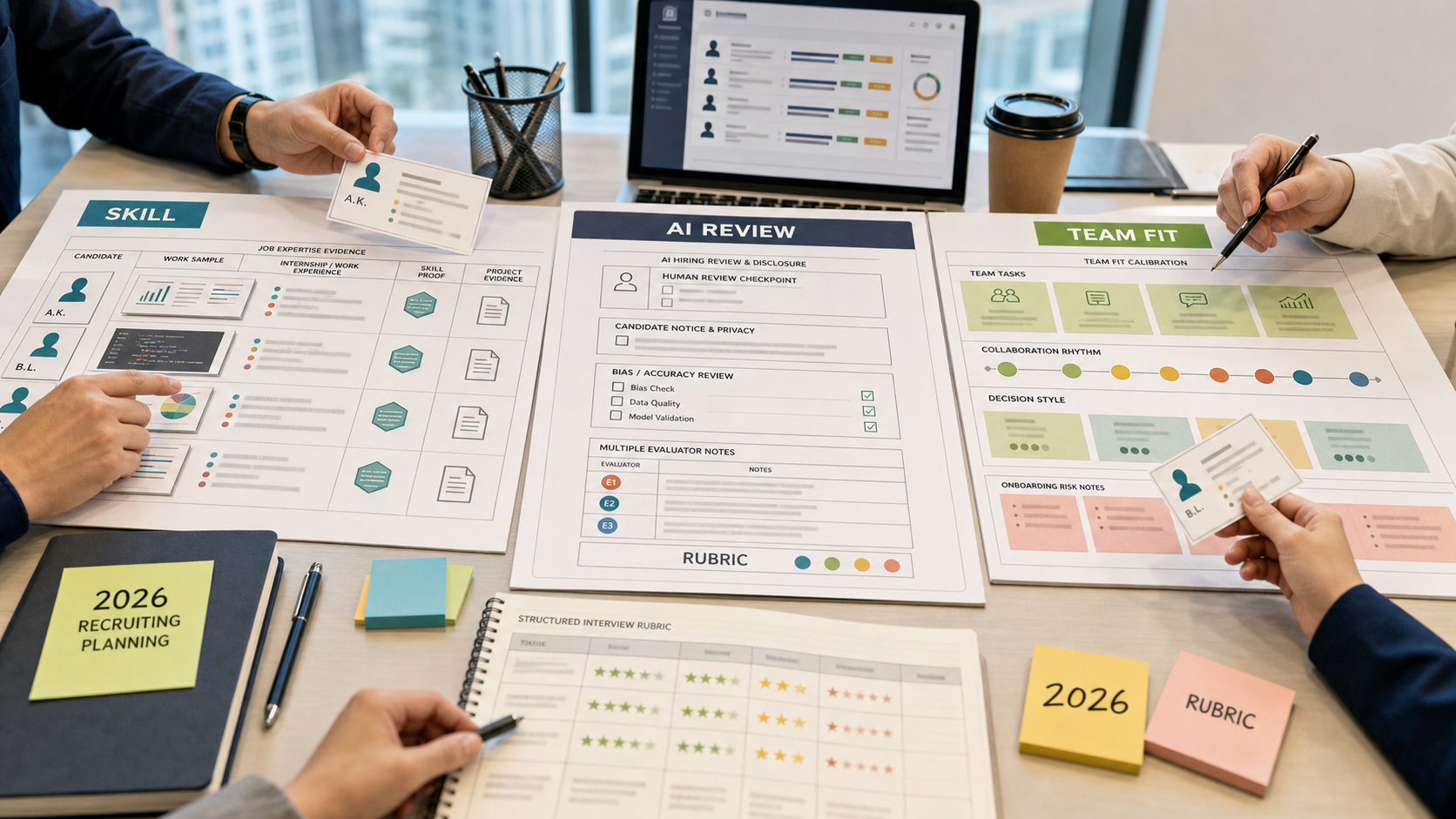
In the Korn Ferry survey, 73% ranked critical thinking as the top factor when evaluating potential candidates, while AI-related skills ranked fifth. In the SHRM survey, 80% of HR professionals also said they had the greatest difficulty finding candidates with systems and resource-management skills such as judgment, decision-making, complex problem solving and time management.
These results show that 2026 skills-based hiring should not move only by lengthening the list of technology stacks. The phrase “experience using generative AI” alone cannot verify a candidate’s work judgment. Selection processes need to include questions that redefine the objective of an assignment, situations that require prioritization with limited information, and moments where the candidate challenges or corrects AI-generated output. Interviewer training also has to change. Interviewers should ask less about which tool the candidate used and more about how the candidate checked the evidence and what risks remained.
Work model is not a benefit but the size of the reachable talent pool
In the Korn Ferry survey, 52% said return-to-office mandates hurt recruiting, and 73% said remote roles were easier to fill. In 2026 global recruiting, work model operates not as an add-on to the compensation package but as a structural variable that determines the candidate pool a company can reach in the first place.
This point also changes the language of employer branding. The phrase “flexible work available” is no longer enough. Candidates look at the team’s meeting rhythm, asynchronous decision-making method, performance-evaluation criteria and onboarding approach. Recruiting teams should compare fill speed, offer acceptance rate and 90-day post-hire adaptation indicators for remote and hybrid roles against office-centered roles. If the effect of the work model is judged only by intuition, the cause of hiring difficulty can be misunderstood as only a compensation or brand problem.
The question Korean HR should import is workforce structure, not tools
Mercer’s Global Talent Trends 2026 surveyed about 12,000 executives, HR leaders, employees and investors across 16 regions and 16 industries, presenting the combination of human capability and automation as a major agenda. Deloitte’s 2026 Global Human Capital Trends, based on a survey of more than 9,000 business and HR leaders in 89 countries and more than 50 interviews, also analyzed the importance of a human-centered approach in AI transformation.
When Korean companies apply this trend, the first thing to examine is not the feature list of AI recruiting solutions. They need to review together how much entry-level hiring will be reduced, where alternative learning paths will be built if it is reduced, who will review AI-generated evaluation results, and how much remote or hybrid conditions expand the candidate pool. The key indicators in a 2026 recruiting strategy meeting are likely to begin with a single view comparing time to hire, candidate conversion rate, offer acceptance rate, 90-day adaptation rate after joining, and internal growth rate for junior positions.
What HR should look at next
The point is not to add one more policy. The work ahead is to turn this issue into a clear operating standard for the organization.
A practical starting question is enough: which decision will this change actually alter — hiring, performance management, learning, or rewards? The clearer that answer becomes, the closer HR work moves from reports to real standards used in the field.
![[2026 HR Trend ④] Skills Criteria Must Change Before Recruiting Automation](https://hr.widion.com/wp-content/uploads/2026/06/1404-distinct-skills_validation_workbench-1.png)