![[2026 Skills Shift ⑧] How to Start Upskilling and Reskilling With a 90-Day Pilot](https://hr.widion.com/wp-content/uploads/2026/06/1769-wide-situational-90-day-skills-pilot.png)
Key Takeaways
Upskilling and reskilling do not need to start as large enterprise-wide projects. In fact, if the scope includes every job, every employee, and every skill from the beginning, it becomes too large and accountability becomes unclear. The approach needed in 2026 is to select one or two critical jobs, run a small 90-day experiment, and expand based on the results.
CompTIA’s 2026 Workforce and Learning Trends reports that 83% of organizations place a high priority on addressing skills concerns, and 62% of HR professionals and IT leaders expect AI training budgets to increase over the next year. However, only 34% of companies have formal, organization-wide upskilling or reskilling programs. Interest and budgets have grown, but execution systems remain insufficient.
Therefore, HRD should begin with a “verifiable pilot” rather than “building a perfect system.” The goal of a 90-day pilot is not to open many courses. It is to select changing work, define required skills, diagnose current levels, design learning pathways and work-application assignments, and then check application results and role-transition potential.
A 90-Day Pilot Should Start Smaller Than an Enterprise-Wide Project
Upskilling and reskilling are strategically important, but execution should start small. If the organization tries to build an enterprise skills dictionary, all-job diagnosis, an integrated platform, and a large-scale training system all at once, timelines stretch and business attention declines. A pilot should be an experiment to confirm what actually works in the organization.
CompTIA explains that in building workforce development programs, training costs as well as execution and measurement are major challenges. Survey populations and industry composition may differ from Korean companies, but the signal is clear: HRD must design workable operations before big slogans.
Deloitte’s 2026 Global Human Capital Trends explains that competitive advantage is shifting from static workforce placement to orchestrating people, skills, data, and technology in real time. From this perspective, a 90-day pilot is not simply training operations. It is a small operating experiment in which HRD, HRBPs, business leaders, people analytics, and IT or HR tech owners connect work, skills, learning, application, and outcome data.
The narrower the pilot scope, the better. For example, choose one or two roles where AI or automation is clearly changing work, such as customer support, recruiting, sales operations, production management, or learning operations. The target group can start not with all employees, but with 20 to 50 people in the job where role-change potential is high. What matters is not the number of participants, but whether real work application can be checked after learning.
Days 1–15: Choose Changing Work and Critical Jobs
The goal of the first 15 days is not to choose training courses, but to choose changing work. The question is not “Let’s run AI training,” but “Which work is being automated, augmented, or redesigned?” At this stage, HR should review business interviews, work lists, recent automation-tool adoption areas, the share of repetitive work, and customer or internal-user complaint data.
CompTIA’s finding that 83% of organizations place a high priority on addressing skills concerns shows the urgency of this stage. SHRM’s 2026 AI in HR report also states that in organizations where AI has been deployed, job responsibility changes were reported at 39%, new roles at 24%, and some job displacement at 7%. This signals that workplace AI has a greater impact on changing job responsibilities and creating new roles.
Therefore, during Days 1–15, three decisions must be made. First, the pilot job. Second, three to five key units of changing work within that job. Third, work assignments whose application results can be checked within 90 days. For a recruiting role, for example, candidate sourcing automation, interview-question design, recruiting data analysis, and onboarding linkage could be candidate areas.
The output of this stage is a pilot topic definition document. It should state “which work change we are responding to” before “whom we will train.” Only then will the later skills map and learning pathway connect to actual work change rather than becoming a training catalog.
Days 16–30: Diagnose the Work-Skills Map and Current Levels
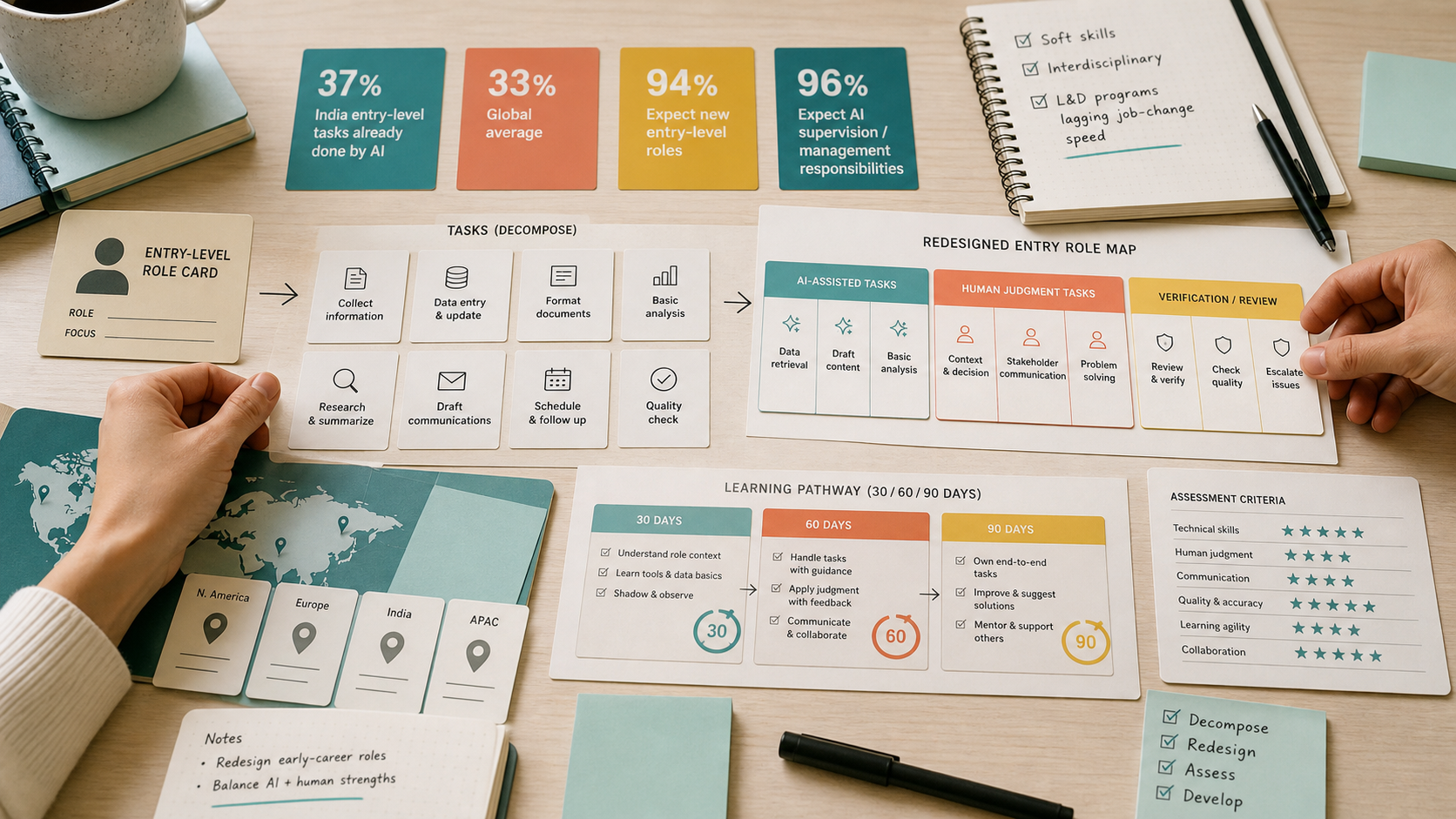
During Days 16–30, create a work-skills map for the pilot job. A skills map is not a massive competency dictionary. In a 90-day pilot, three to five changing units of work and five to ten skills required to perform that work are enough. For example, “recruiting data analysis” might connect to data cleaning, metric interpretation, bias review, business reporting, and AI tool use.
CompTIA identifies current training formats such as job role-based training at 64%, foundational AI skills training at 64%, workflow-related training at 62%, and advanced AI training at 53%. These figures show that learning design is moving toward job-role and workflow units. Therefore, the skills map should not list abstract competencies under a job title, but should be built around work and observable performance behaviors.
Current-level diagnosis does not need to be complex at the beginning. Self-diagnosis, manager confirmation, simple task performance, and review of existing outputs can be combined. A four-level proficiency scale is enough: Level 1 is conceptual understanding, Level 2 is performance with a guide, Level 3 is independent performance, and Level 4 is coaching others or proposing work improvements.
The outputs of this stage are a work-skills map and a current-level diagnosis table. The important point is to communicate that the diagnosis is not an evaluation. The pilot diagnosis is not a tool to rank employees; it is the starting point for designing learning and work application over the 90 days.
Days 31–60: Design Learning Pathways and Work-Application Assignments Together
During Days 31–60, design the learning pathway. The common mistake at this stage is to arrange only courses. A reskilling pilot’s learning pathway must include content, practice, business assignments, and manager feedback. The structure should not end with course completion; it should require at least one actual application in work.
TalentLMS’s 2026 L&D Report identifies ways companies respond to skills gaps: upskilling or reskilling current employees at 64%, automating work with AI at 62%, and hiring external specialists at 57%. This signals that companies use multiple responses together. HRD should design learning pathways for internal employees while also considering which work will be automated and which roles may need external hiring.
A learning pathway can be designed in three layers. The first is common foundational learning, such as understanding AI, data, and work change. The second is work-specific practice, using documents, data, customer issues, or processes that employees actually use in their jobs. The third is an application assignment: a small improvement assignment that can be performed in the business within two to four weeks.
The outputs of this stage are a learning pathway table and a list of work-application assignments. Assignments must be defined together with business leaders. Assignments created by HRD alone may not match actual business priorities. Pilot success depends less on the completeness of training content and more on whether work-application assignments are actually performed.
Days 61–90: Validate Application Results and Role-Transition Potential
During Days 61–90, confirm application results. What must be checked is not completion rate alone. HR should examine which work employees applied the learning to, what outputs were produced, whether managers confirmed them, and whether the skill can expand into other work or adjacent roles.
TalentLMS reports that 44% of HR managers prioritize external candidates over internal employees for new roles, while recommending that organizations build internal mobility paths and use skills data to assess role readiness before hiring externally. From this perspective, a 90-day pilot is also an experiment in checking the role readiness of internal candidates.
SHRM reports that 56% of HR organizations do not formally measure the success of AI investments. To avoid this measurement gap, minimum validation criteria must be set before the pilot ends. Examples include completion of application assignments, output quality, manager confirmation, reduced work time, error reduction, customer or internal-user response, and readiness for adjacent-role assignment.
The output of this stage is a pilot results report. A good report does not end with “how many people completed the program.” It should show which work changed, which skills were needed, who reached which level, which work the learning was applied to, and what should be expanded in the next 90 days.
Five Outputs HRD Should Leave After the Pilot
When the 90-day pilot ends, HRD should leave behind scalable operating assets, not just a training results report. Considering TalentLMS’s supporting L&D success indicators—business impact at 37%, career growth outcomes at 31%, and training satisfaction at 28%—the outputs must explain training operations together with career and work outcomes.
First, a work-change map for the pilot job. It should organize which work is shrinking, which work is growing, and which work is newly emerging.
Second, a work-skills map. Instead of listing competencies under a job title, it should connect changing work, required skills, and proficiency standards.
Third, learning pathways and application-assignment lists. The organization should record which learning content, practice, and business assignments actually worked so that the model can expand to the next job.
Fourth, skills diagnosis and application-results data. Pre- and post-level changes, assignment outputs, manager confirmation, and project assignment should be organized.
Fifth, an expansion decision proposal. HRD should recommend which job should be the next pilot, whether a platform or external training is needed, and how the next stage should connect to internal mobility or role transition.
If these five outputs remain, the 90-day pilot becomes the starting point for a skills-based HRD operating model rather than a one-off training program. Deloitte’s real-time orchestration of people, skills, data, and technology also becomes possible when these small operating assets accumulate.
What HR Should Watch Next
Upskilling and reskilling in 2026 are not about increasing the training list. They are about connecting work change, skills data, learning pathways, work application, and performance metrics into one flow. The core message of this series is the same: reskilling is not about selecting people whose jobs will disappear, but about finding changing work and roles into which people can move.
HRD must now ask “which work change should we respond to?” before “what should we teach?” And it must explain “who became able to perform which new work?” rather than “how many people completed the course?” Skills data and performance indicators make that explanation possible.
A 90-day pilot is a realistic way to start this transition. There is no need to wait for an enterprise-wide project. Start with one or two critical jobs, three to five changing units of work, five to ten required skills, and a few application assignments. Start small, but leave data and outcomes behind. Only then will upskilling and reskilling become not buzzwords, but an HR strategy that changes how the organization works.
![[2026 Skills Shift ⑦] Reskilling Metrics: Completion Rates Are Not Enough](https://hr.widion.com/wp-content/uploads/2026/06/1768-wide-situational-reskilling-metrics-beyond-completion.png)
![[2026 Skills Shift ⑥] The Skills Data to Design Before an AI Learning Platform](https://hr.widion.com/wp-content/uploads/2026/06/1767-wide-situational-skill-data-before-platform.png)
![[2026 Skills Shift ⑤] Selecting Reskilling Candidates: Look at Work Change, Not Job Titles](https://hr.widion.com/wp-content/uploads/2026/06/1766-wide-situational-reskilling-target-selection.png)
![[2026 Skills Shift ④] Skills-Based Organizations: How to Avoid Ending as a Training Team Project](https://hr.widion.com/wp-content/uploads/2026/06/1765-wide-situational-skills-based-organization-workshop.png)
![[2026 Skills Shift ③] In the AI Era, Employees Need More Than Coding Skills](https://hr.widion.com/wp-content/uploads/2026/06/1764-wide-situational-ai-skills-verification-collaboration.png)
![[2026 Skills Shift ②] Upskilling vs. Reskilling: The Standard for Dividing HRD Budgets](https://hr.widion.com/wp-content/uploads/2026/06/1763-wide-situational-budget-split-upskilling-reskilling.png)
![[2026 Skills Shift ①] Why Upskilling and Reskilling Are Back at the Center of HR’s Agenda](https://hr.widion.com/wp-content/uploads/2026/06/1762-wide-situational-skills-shift-agenda.png)