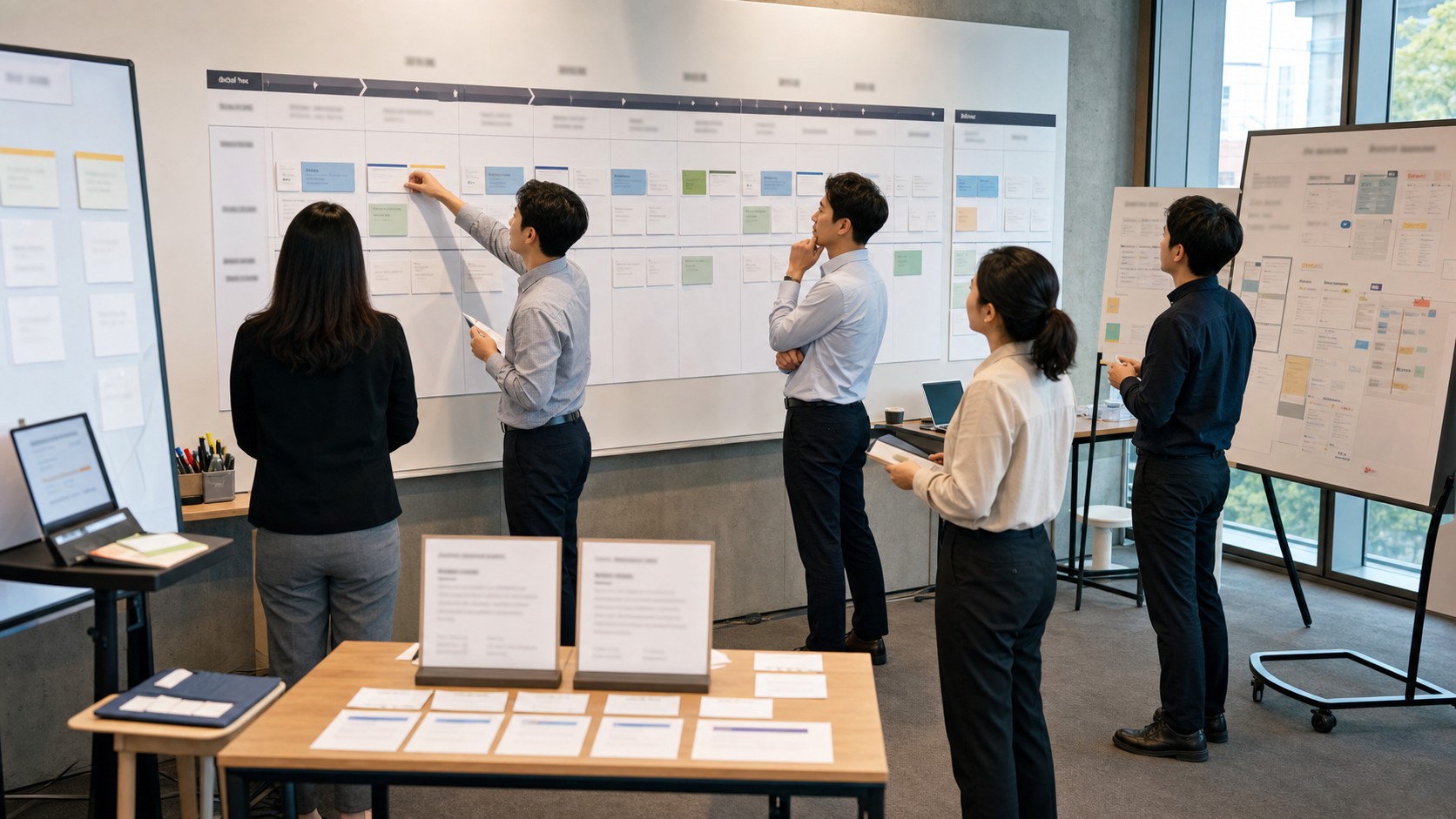
When organizations begin writing OKRs, they first tend to cling to the wording. They try to make the Objective sound more impressive and turn the Key Results into more precise numbers. But good OKRs are not a matter of writing skill. They are a matter of deciding what to give up and what to focus on.
As discussed in the previous articles, KPIs are indicators for observing the state of an organization, while OKRs are a device for asking what direction the organization intends to change during this period. If this difference is not reflected in the design of Objectives and Key Results, OKRs quickly become a task list or an evaluation sheet. Good OKRs ask not “what will we do?” but first “what change must actually happen during this period?”
An Objective is not an impressive sentence, but a device for deciding what to give up
Google’s OKR playbook describes Objectives as “Whats.” This means they should show what is to be achieved and what intent and direction are involved. It also says that a successfully achieved Objective must provide clear value to the organization. In this sense, an Objective is not a slogan but a sentence of choice.
For example, the phrase “create the best employee experience” sounds good, but it does not show a choice. It does not reveal which employee experience matters, why it matters now, what will be given up, or where attention will be focused. By contrast, “redesign the onboarding experience to reduce first-90-day attrition risk for new hires” is narrower. That is why it is more operational.
A good Objective turns broad desire into a narrow priority. If an HR department writes that it will change recruiting, training, evaluation, organizational culture, labor relations, and HR Tech all in one quarter, it is the same as choosing nothing. An Objective must set the direction in which the organization will move most significantly during this period and draw a line that leaves other work as KPIs or ordinary operations.
The difference becomes clearer in practice. If an HRD team writes “improve satisfaction with leadership training” as its Objective, it is likely to remain at the level of improving training operations. By contrast, if it writes “reduce early 90-day management failures among newly appointed team leaders,” it will look together at onboarding, 1:1 meetings, feedback quality, and signals of team member attrition. A good Objective is not a pretty sentence; it reveals the scene the organization actually needs to change.
Key Results should be visible results of change, not an execution list
Google’s playbook describes Key Results as “Hows,” but it also emphasizes that KRs should describe results, not activities. The original text warns that KRs containing words such as consult, help, analyze, and participate may be signals that they are describing activities. This applies directly to HR practice.
“Conduct three manager training sessions” may look like a KR, but in reality it is an activity. “Carry out interviews with all employees” is the same. Training and interviews may be important. However, unless they show what change they created, they are unlikely to become true Key Results for OKRs. Whether managers’ feedback quality improved after training, whether the retention risk of key talent fell after interviews, or whether the time for new hires to reach productivity decreased is closer to a result.
What Matters explains that an OKR is usually composed of 3 to 5 Key Results under one Objective. This number is not merely a format but a quality standard. If there are too many KRs, they become a task list rather than results. Items that cannot fit within 3 to 5 may not be the core change of this Objective.
HR department OKRs should ask about organizational behavior change rather than activity volume
OKRs in HR departments are especially prone to drifting toward activity volume. Recruiting teams can easily write the number of job postings and interviews, HRD teams the number of training sessions and completion rates, and organizational culture teams the number of campaigns and participation rates. These indicators may be useful as KPIs. But to become KRs in OKRs, they must show behavior or results that changed after the activity.
For example, if the recruiting team’s Objective is “increase decision-making speed for hiring in critical roles,” a KR could be written as “reduce the median time from interview completion to offer decision from 7 days to 4 days.” If the HRD team’s Objective is “reduce early management failures among new leaders,” a KR could be designed as “increase the rate of 1:1 feedback within 60 days of new leader assignment from 40% to 85%.”
The same applies to organizational culture teams. “Run five campaigns” is less like an OKR than “increase the share of issues converted into action items in team retrospective meetings from 30% to 60%.” What matters is not evidence that many good activities were carried out, but evidence that the organization’s behavior actually changed.
A good OKR meeting is not a meeting that adds goals, but one that reduces them
Atlassian’s OKR guide presents a flow for defining 1 to 3 Objectives and setting 3 to 5 Key Results for each Objective. Although it has the limitation of being vendor material, these numbers are practically useful. They show that an OKR meeting should not be a place that keeps adding goals, but a place that reduces them.
Goal-setting meetings in Korean companies often flow in a way that reflects the demands of every department. Executive priorities, division head instructions, requests from the field, and existing KPIs enter one document together. When this happens, OKRs become the outcome of stakeholder coordination rather than a tool for creating strategic focus.
A good OKR meeting requires three questions. First, what must be changed during this period? Second, what will be given up for this Objective or managed only as a KPI? Third, do the KRs show results rather than activities? If a goal cannot pass these questions, it should be reduced rather than written in further detail.
The failure factors in the next installment appear in operating rhythm rather than writing methods
Creating good Objectives and Key Results does not mean OKRs will work. Even good sentences become end-of-quarter evaluation materials if there is no operating rhythm. If check-ins turn into reporting meetings, if there are no criteria for changing goals, and if leaders do not remove obstacles, OKRs become extra work for the field.
So, the final step in writing OKRs is not reviewing the wording, but agreeing on operations. Who will check progress, and at what cadence? Who has the authority to revise goals when KRs become unstable? Who will coordinate conflicts between departments around shared goals? Will achievement rates be viewed as evaluation scores or as material for performance conversations?
OKRs are not a technique for writing good sentences, but a way to reveal the organization’s choices. Objectives show what has been chosen, and Key Results confirm whether that choice has turned into actual results. If this standard cannot be maintained, OKRs become another name for KPIs. If it can be maintained, OKRs can move performance management conversations from activity volume to evidence of change.
What HR should look at next
The point is not to add one more policy. The work ahead is to turn this issue into a clear operating standard for the organization.
A practical starting question is enough: which decision will this change actually alter — hiring, performance management, learning, or rewards? The clearer that answer becomes, the closer HR work moves from reports to real standards used in the field.