
The Corporate Recruiting Trends Survey released by the Ministry of Employment and Labor and the Korea Employment Information Service in November 2025 clearly shows the starting point for Korea’s 2026 recruiting market. The survey covered companies and young workers from August 1 to September 1, 2025, with 396 companies and 3,093 young employees across all 17 cities and provinces. In this sample, 52.8% of responding companies said they primarily require expertise when hiring young workers. Another 85.4% said applicants’ work experience helped them adapt to the organization and job after joining.
Meanwhile, the second announcement found that 86.7% of companies use AI tools in HR work. Only 21.7% currently use AI in formal recruiting procedures, but 74.5% plan to introduce or expand it in recruiting. Korea’s 2026 recruiting agenda is moving less toward expanding hiring volume and more toward turning three standards into operating documents: expertise verification, fairness in AI use, and team-level fit.
Expertise is narrowing from major to job-related experience
In the Ministry of Employment and Labor’s 2025 Corporate Recruiting Trends Survey, 52.8% of companies said they prioritize expertise when hiring young workers. The items used to evaluate expertise were major at 22.3%, work experience such as internships at 19.1%, and job-related education or training at 17.4%. A major still matters, but companies are no longer judging expertise only by the name of a major. They are also looking for traces of experience and training connected to the job.
This change alters the question in entry-level recruiting. “What was your major?” is becoming less important than “How much have you experienced the problems of this role?” Recruiting teams need to break the expertise required in job descriptions into knowledge, practical experience, tool use, and collaborative outputs. Interviews should not stop at hearing an explanation of the applicant’s major. They should check what assignments the applicant carried out and by what standard the results were judged.
Work experience becomes evidence of adaptability, not a specification
In the Ministry of Employment and Labor survey, 85.4% of companies assessed that applicants’ work experience helped them adapt to the organization and job after joining. When reviewing work experience, the most important criterion was relevance to the hiring role at 84.0%, followed by outcomes produced during the experience at 43.9% and whether the experience existed at 39.5%.
These figures mean work experience should not be read as a simple list of credentials. What companies examine is not the existence of experience, but job relevance and outputs. In recruiting, internships, projects, and completed training should not simply be placed in the same table. They should be evaluated separately by job-related task, role, tools used, deliverable, and feedback. Young applicants also need an application structure that can explain not just “I have experience,” but “how this experience is related to the hiring role.”
AI recruiting requires prior notice and verification before efficiency
In the second Ministry of Employment and Labor announcement, 86.7% of the 396 responding companies were using AI tools in HR work. Companies using AI tools for employee recruiting accounted for 21.7%, and 74.5% planned to introduce or expand AI tools in recruiting work. Use cases included AI-based aptitude or competency tests at 69.8%, application-document screening at 46.5%, and use of results from AI interviews or in-person interviews at 46.5%.
What recruiting teams must decide first is not whether to introduce AI, but the operating standard. They need to inform applicants in advance which stages use AI, what evaluation factors are involved, how collected personal information is handled, and how people intervene in the final decision. Since the reasons for introducing AI were data-based judgment at 34.6% and shorter screening time at 31.5%, it will be difficult to explain the effect of AI adoption unless efficiency and fairness indicators are managed together.
Candidate experience now includes explainability in AI screening
In the Ministry of Employment and Labor survey, 23.7% of young people had experienced an AI recruiting process during job search, and 63.8% supported companies operating AI recruiting processes. But their concerns were specific. Young people were worried about fairness in AI judgment criteria at 26.9%, opacity in AI screening standards at 23.1%, and distortion of self-expression at 18.4%.
Candidate experience no longer ends with interview scheduling or quick feedback. In AI screening, job seekers requested verification of evaluation accuracy at 47.1%, bias verification at 42.3%, and prior notice of evaluation factors at 41.5% as protection measures. Companies must decide how far they can explain AI evaluation results to candidates, whether they will provide objection or review procedures, and how interviewers will refer to AI results. Without these standards, candidate experience may become more convenient but less transparent.
From culture fit to team fit, the verification unit moves down to the team
Wanted said in its 2026 recruiting trend material released in December 2025 that it asked 153 HR professionals about 2026 recruiting plans and outlooks. The central keyword of the material is team fit beyond culture fit. The direction is moving beyond finding people who fit the whole organization and toward checking whether candidates fit the actual team’s tasks, pace, and collaboration style.
Team fit is risky when judged by intuition. The phrase “this person fits our team” can easily drift into an interviewer’s personal preference. Team-fit verification should therefore be broken down into the team’s current tasks, complementary capabilities needed, collaboration rhythm, and decision-making method. For example, selection criteria can differ for the same role depending on whether the team needs rapid experimentation, stable operational quality, or frequent customer communication. If team fit is used, the evaluation sheet should also separate organizational-culture fit, job fit, motivational fit, and team complementarity.
Even if hiring volume declines, selection difficulty does not fall
Jobkorea’s Corporate Lounge article on 2026 recruiting strategy cited the Korea Enterprises Federation’s 2025 new hiring survey and said 60.8% of companies had plans for new hiring. The same article, based on Saramin data, explained that among companies that recruited in 2024, 49.7% failed to hire as much as planned, and 63.6% cited the absence of suitable applicants as the reason.
This shows that a conservative hiring stance does not mean selection becomes easier. When hiring volume shrinks, the cost of a single failed hire becomes larger. Companies therefore review more devices such as direct sourcing, referrals, talent pools, structured interviews, multiple evaluators, and bar raisers. In 2026, the recruiting team’s role is moving closer to that of a business partner that works with business leaders to define which candidates the company must not miss, rather than a function that opens postings and processes applicants.
Recruiting meetings in 2026 should review job, team, and AI standards together
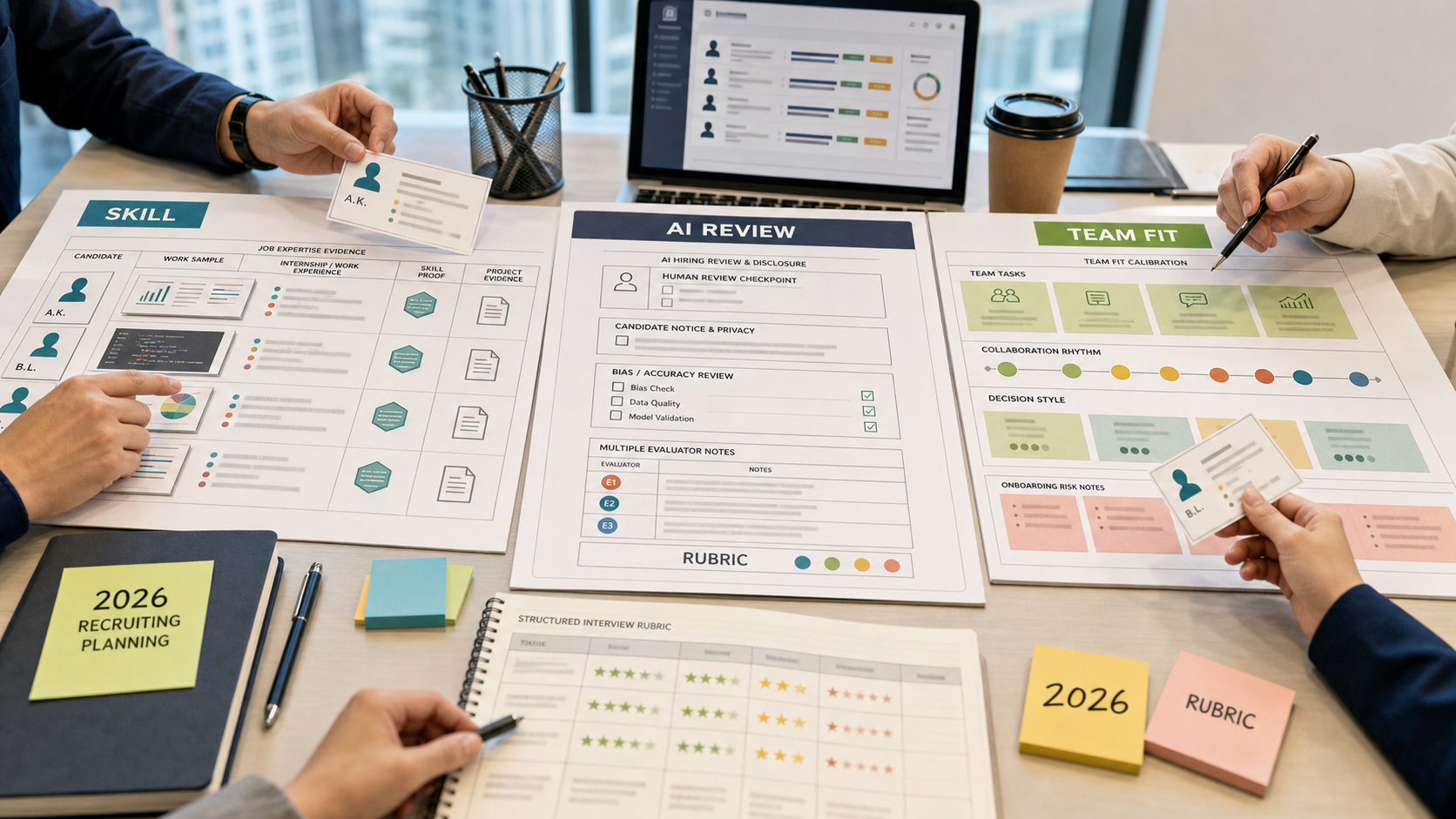
When setting Korea’s 2026 recruiting strategy, HR should check at least three tables. First is the expertise criteria table by role. Major, work experience, job training, certifications, and outputs should be compared under the same standard. Second is the team-fit criteria table. Team tasks, complementary capabilities, collaboration style, and onboarding risks should be defined with business teams. Third is the AI recruiting operating table. It should leave records of AI-use stages, prior-notice wording, personal-information handling, human final judgment, and bias-review checks.
If these three tables are separated, recruiting returns to a matter of intuition and speed. Organizations must be able to distinguish candidates who have high expertise but do not fit the team’s task, candidates who fit the team but are difficult to explain under AI evaluation criteria, and candidates selected quickly but showing low 90-day adaptation indicators after joining. Korea’s 2026 recruiting challenge is not only about gathering more applicants. It is about making the organization able to explain by what standards it selected people within fewer hiring opportunities.
What HR should look at next
The point is not to add one more policy. The work ahead is to turn this issue into a clear operating standard for the organization.
A practical starting question is enough: which decision will this change actually alter — hiring, performance management, learning, or rewards? The clearer that answer becomes, the closer HR work moves from reports to real standards used in the field.
References
- Ministry of Employment and Labor, First announcement of the 2025 Corporate Recruiting Trends Survey results
- Ministry of Employment and Labor, Second announcement of the 2025 Corporate Recruiting Trends Survey results
- Wanted, Recruiting Trends 2026: From Culture Fit to Team Fit
- Jobkorea, Changing Recruiting Conditions and 2026 Recruiting Success Strategy